

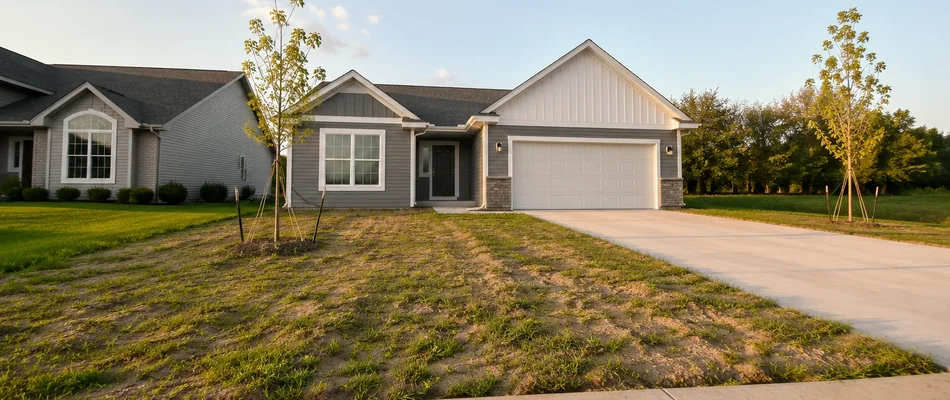
It’s early August, you moved into the new house, and yours is the roughest lawn on the street. Thin through the middle. Weedy along the edges. Hard as a sidewalk when you push a shovel into it.
Here is the short version. You didn’t do anything wrong. This is a sequence problem, not an effort problem. A new construction lawn starts from a different place than an established one, and most of what you see was decided by the builder before you got the keys.
What a Builder Lawn Starts With on Day One
On a new lot, the topsoil comes off first. Then the house gets built on whatever is underneath, which around here is usually heavy clay subsoil.
That subsoil takes a beating for months. Concrete trucks, excavators and framing crews drive and park on it, often when it’s wet. By then the ground under your lawn has been compressed by equipment weighing many tons.
Then a thin layer of soil goes back over the top, sometimes four inches, sometimes closer to two, and sod or seed goes down on that. So the lawn you inherited is working with:
- Very little organic matter, because the good soil went somewhere else
- Dense ground that roots have a hard time pushing into
- Uneven settling over backfill and buried debris
- A grade set for drainage, not for growing grass
Weeds are not evidence of neglect. They are evidence of thin turf and open soil. That is a starting condition, not something you did, and it responds to the Roadmap to a Sharp Lawn once things happen in the right order.
Is There a Special First Year Lawn Program?
There is no special first year program at Sharp. There is a readiness gate, then normal service. The gate depends on how your lawn went in.
- New sod. The gate is rooting. Fresh sod is a living carpet sitting on the soil. Until it knits down and pushes roots into the ground, it is a guest, not a resident. Once it has rooted, it gets serviced like any other lawn.
- New seed. The gate is maturity, and the calendar is the wrong measuring stick. Mowings are the right one. The stand needs a few mowings behind it, typically around the six to eight week mark. Then it is serviced as normal.
Once a lawn clears the gate, we pick up wherever we are in the calendar with whatever is due. We do not restart at step one. Our breakdown of the lawn care packages covers each tier.
What a New Construction Lawn Needs First, In Order
Order is the whole game on a new lot.
- Feed new sod once it has knit down to the soil, not the week it goes in. That is roughly two to six weeks, depending on soil temperature and watering, and sod laid into hot ground may not push new roots until temperatures break. Year one is smaller amounts more often, and a long wait shouldn’t push that first feeding past about the middle of October. Broadleaf weed control is limited by the same thing and stays off until the sod is anchored.
- Feed new seed light and often. A starter fertilizer goes down at seeding. Iowa State puts the first follow up at about three to four weeks after the grass comes up, when blades are roughly one to one and a half inches tall, and another follows a few weeks later. Same thinking as our ongoing fertilization program.
- On new seed, let mowings decide when weeds get treated. Purdue says it plainly: wait until a recently seeded lawn has been mown two to three times before standard broadleaf products go down. Products labeled for use at seeding are gentler and can go sooner, which is why our one-time Ground Prep and Seeding service, which requires an aeration add-on, includes one.
- Mind the gap between weed control and seeding. Kansas State puts roughly thirty days between a broadleaf treatment and seeding that same area. In August, a weed treatment now can push a September seeding.
Why a Spring Pre-Emergent Can Kill New Grass Seed
This one costs homeowners a whole fall. A pre-emergent does not stop seed from sprouting. The seed germinates, and then the young seedling is killed before it can root. It does that to good grass seed the same way it does to crabgrass. So a homeowner who seeds into treated ground sees green fuzz come up, decides it took, then watches it die.
A spring pre-emergent usually still leaves the late summer window open, but how long it holds depends on what went down, at what rate, and on what date, so we check the record before scheduling core aeration and seeding. Asking your builder what was applied is a fair question.
Mow a New Seeding Short, Then Step It Back Up
We spend most of our time telling people to mow tall. That guidance is written for established lawns.
A brand new seeding is a deliberate, temporary exception. Purdue Extension puts it this way: “Mow at 1.5 inches 2-3 times, then increase mowing height at 1/2 inch intervals until the normal 2.5 to 3.5-inch mowing height is reached.”
The reason is light. A new stand needs sun at the crown so it tillers and fills in sideways, and a tall canopy shades out the seedlings you are trying to establish. Within a few weeks the lawn steps back up to our usual mowing height guidance. Our guide on watering a newly reseeded lawn covers the other half.
Timing a New Construction Lawn in Sioux Falls, SD
The seeding window for eastern South Dakota runs from about the middle of August into the middle of September. SDSU Extension calls late summer the best time of year to seed a lawn, and NDSU advises getting seed down by the middle of September so it establishes before winter.
Inside that window, earlier beats later, because bluegrass and fine fescue can take two to three weeks just to germinate.
New lots across the Sioux Empire tell the same story, in Harrisburg, Tea, Brandon, Hartford, Lennox, Canton, and the rest of the Sioux Falls service area. Different builders, same scraped clay.
If Your Builder Handed You Bare Dirt in October
Closing slips, the landscaper gets backed up, and the window closes on a yard that is still dirt. The answer is not to wait for spring. It is dormant seeding, where seed goes down late enough to sit through winter instead of germinating, then comes up as soon as soil temperatures allow.
What Core Aeration Can and Cannot Fix on a Builder Lot
Sharp only puts seed down through aeration, so overseeding and aeration happen together. Aeration is the most useful thing you can do to a new lot, and it is also routinely oversold.
- New sod has to be securely rooted before a machine goes over it, meaning at least two months after installation and closer to three to six months on heavy clay. Sod can feel anchored underfoot within a couple of weeks and still be nowhere near ready.
- A newly seeded lawn is judged on whether it is rooted deeply enough to knit back together after coring instead of tearing. A lawn seeded in spring is usually ready by that same late summer window. A lawn seeded in fall waits.
Core aeration works in the top few inches, roughly three. Construction compaction reaches twelve to eighteen inches, and remediating that means ripping, which is grading work. So aeration genuinely improves the soil you have, but it cannot fix deep construction compaction, add topsoil, correct a grade that runs toward the house, or level settling over buried debris.
Those are builder problems, and far cheaper to solve before a lawn goes in. Sharp doesn’t grade, haul topsoil, install sod, or do irrigation work.
What we do is work that top layer season after season, backed by soil work where soil is the limiting factor. That is not a consolation prize, it is the actual mechanism. Cores pulled every year. Seed dropped into the holes. Clippings returned. Roots growing, dying, and leaving organic matter behind where the last root was. The layer your grass actually lives in gets deeper and more forgiving every season, while the subsoil stays whatever the builder left it. That is how a rough builder lot turns into the good lawn on the street, and it is why the Roadmap repeats aeration instead of selling you a one time fix. If yours is past new and still thin, our guide to restoring a thin, patchy lawn picks up there.
Where Liquid Aeration Fits on a New Lot
Core aeration is our first recommendation, and on Sioux Falls clay it is the tool that does the heaviest lifting. But there is a second option that matters more on a builder lot than almost anywhere else, and it happens to be the one soil service we can run while a young lawn is still off limits to a machine.
Liquid aeration is a sprayed treatment carrying a soil penetrating agent, a surfactant, and nutrients. As it moves into the ground it creates tiny pores that loosen compaction over time. Its advantage is reach. A core aerator pulls plugs from the top few inches. A liquid treatment travels with water, so it works down to roughly a foot, into the upper part of the packed layer a machine never touches.
That does not make it a replacement for coring, and it is not a fix for the deepest construction compaction. The bottom of that layer is still a grading problem, and it stays one. What it does is widen the band of soil you are actually improving, which is why the two are worth running together. They work at different depths, so they are complementary rather than competing.
The bigger reason it belongs in a first year conversation is timing. Coring is off the table until sod has rooted or a seeded stand has matured, and on a builder lot that wait can run months. Liquid aeration is gentle enough for thin and delicate lawns because nothing mechanical touches the turf, and it runs in spring as well as fall. So it is the one thing we can put on a brand new lawn while it grows into the coring gate, instead of asking you to wait and do nothing. Our liquid aeration service page has the full breakdown.
Common Questions About New Construction Lawns
How soon can new sod be core aerated?
Not until it is securely rooted, which means at least two months after installation and often three to six months on the clay under new lots.
Can you seed my lawn if a pre-emergent already went down this spring?
Often yes, but we check first. A spring pre-emergent usually still leaves the late summer window open, though it depends on what went down, at what rate, and on what date. Seeding into an active pre-emergent wastes the seed and the season.
Why does my new lawn have more weeds than my neighbor’s older lawn?
Because weeds colonize open soil, and a builder lot is mostly open soil. An established lawn crowds out what blows in. A new lawn is not there yet. Thickening the turf is the long term fix.
Should I do liquid aeration or core aeration on a new construction lawn?
Both, if you can. Core aeration is the priority once your lawn is rooted well enough to take it, because pulling plugs is what relieves compaction right in the root zone. Liquid aeration reaches deeper and is gentle enough to run before the lawn can handle a machine, so on a new build it is usually the one that comes first.
Get a Straight Answer on Your Builder Lawn
You don’t need a special first year program. You need someone to tell you what stage your lawn is in and what is due next. If yours is the worst lawn on the block, that is a starting point, not a verdict.
Tell us whether you have sod or seed and when it went in, and we will tell you what it is ready for. Look over our pricing, or get a free quote below.
Rather talk it through? Call the Sioux Falls office at (605) 251-6880.


Comments (0)
Thanks for your comment!
Thanks for your feedback! Your comments have been successfully submitted! Please note, all comments require admin approval prior to display.
Error submitting comment!
There is a problem with your comment, please see below and try again.