

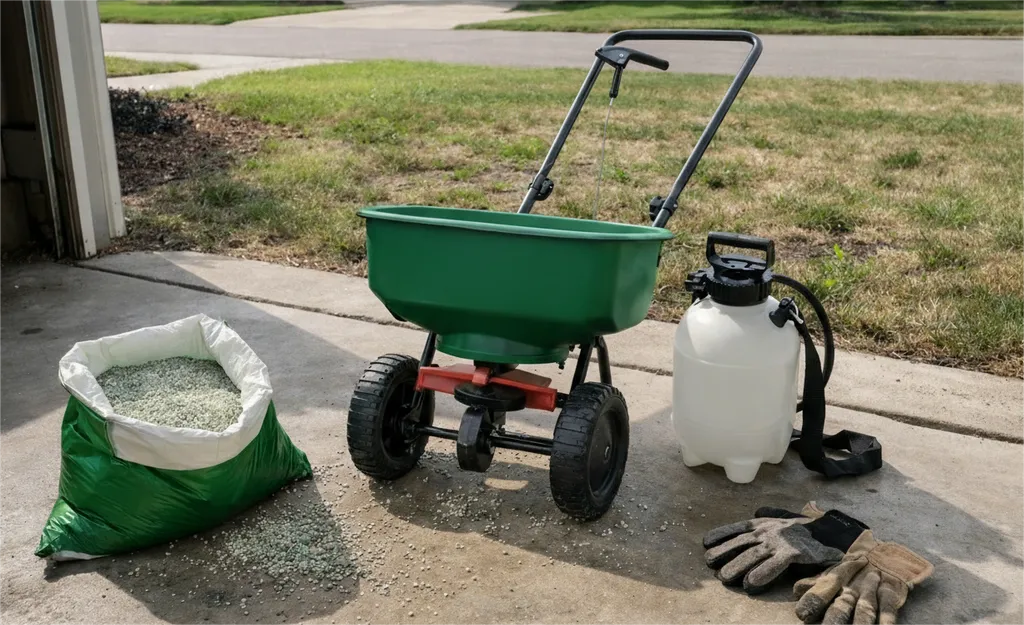
Every spring, homeowners look at their lawn care bill and think the same thing: I could do this myself and save the money. It sounds reasonable. Buy some bags at the hardware store, spread them a few times a year, and pocket the difference. But the reality of DIY lawn care is very different from the expectation. The products are not the same, the costs are higher than you think, and the results almost never measure up.
Before you cancel your professional program to go the DIY route, here is what the real numbers and real outcomes actually look like.
The DIY Lawn Care Price Tag: What It Actually Costs in Sioux Falls, SD
Most homeowners assume DIY lawn care will save them a significant amount of money. The math tells a different story. For a typical 8,000 to 10,000 square foot Midwest lawn, here is what the popular Scotts 4-Step program actually costs:
- Scotts 4-Step products (15,000 sq ft size, which is the minimum for most Sioux Falls properties): $230 to $290 per year
- Broadcast spreader (a decent one that applies evenly): $90 to $130
- Pump sprayer (for spot treatments): $50 to $80
- Aerator rental (if you aerate, which you should): $60 to $80 per rental
- Grass seed (for fall overseeding): $40 to $80
First-year total: $470 to $660. Subsequent years without equipment purchases still run $330 to $450. And this is before you factor in your time, water costs, or the cost of fixing any mistakes along the way.
Compare that to a professional Essentials package that includes five targeted treatments with commercial-grade products, applied by trained technicians, with a satisfaction guarantee. The gap is much smaller than most people expect, and in many cases, it disappears entirely once you account for the full cost of DIY.
Why Store-Bought Products Don’t Deliver the Same Results
The 4-step and 5-step bag programs at the hardware store look straightforward. But these products are not the same as what a professional fertilization program uses. The differences are significant:
- Slow-release technology: Consumer fertilizers typically use 0 to 10% slow-release nitrogen. Professional commercial-grade products use 30 to 50% slow-release nitrogen with polymer coatings that feed your lawn steadily over weeks. Retail products give a quick green-up that fades just as fast.
- Herbicide concentration: Store-bought weed control products use lower concentrations of active ingredients. Professional-grade herbicides are significantly more potent and are targeted to the specific weeds active in your lawn at that point in the season.
- Same formulation every time: The bag programs give you the same basic product at every step. A professional program changes the formulation at every visit based on seasonal needs: pre-emergent in spring, slow-release organic-base in summer, root-enhancing potassium in fall, winterizer to close the season.
- No grub control, no insect control, no winterizer: Most consumer programs do not include grub prevention, surface insect control, or a winterizer treatment. These are separate purchases that add even more cost and complexity.
The same NPK number on two different bags does not mean the same performance. Delivery mechanism, release rate, and formulation quality matter enormously, and they are where professional products pull away from retail.
The Pre-Watering Trap: Why Granular Weed Control Often Fails
This is the detail that catches almost every DIY homeowner. Granular weed-and-feed products (which is what most store-bought programs include) must physically stick to the surface of weed leaves to be absorbed. If the grass is dry when you apply it, the granules bounce right off the weeds and fall to the soil. The herbicide never reaches the plant. Your money is wasted.
Iowa State University turfgrass research confirms it: granular herbicide must be applied to a wet lawn so the dry pellets adhere to weed leaves. That means you either need to apply early in the morning when dew is still on the grass, or pre-water your entire lawn before you spread.
But it gets harder. After application, you need 48 to 72 hours with no rain or watering so the product stays on the leaf surface long enough to work. That is an extremely narrow weather window that most homeowners cannot control.
Professional lawn care companies avoid this problem entirely. Liquid herbicide spray dries on contact, stays on the leaf surface even through rainfall, and achieves significantly higher weed control rates than granular products. This single difference is a major reason why 43% of homeowners say weed control is their biggest lawn care challenge.
Timing and Expertise: What You Don’t Know Costs You
Lawn care is a sequence, not a checklist. Every step affects the next one, and the timing of each step matters as much as the product itself:
- Pre-emergent timing: Apply too early and it breaks down before crabgrass germinates. Apply too late and the crabgrass is already up. The window is specific to soil temperature, not the calendar.
- Seeding conflicts: If you seed in the spring, you have to skip the pre-emergent (it prevents grass seed from germinating too). That means crabgrass runs wild all summer. You end up spending the season fighting weeds, creating bare spots, and needing to seed again in fall. You pay twice.
- Fall seeding window: There are only about three weeks per year that are ideal for overseeding. Seed outside that window and germination rates drop dramatically.
- Watering mistakes: Research shows that 70% of poor lawn health is caused by improper watering. Most homeowners water too frequently and too shallow, which keeps roots near the surface where they are vulnerable to heat and drought.
- Fertilizer application: Over 55% of homeowners don’t know their soil pH before applying fertilizer. Without that information, you are guessing, and guessing leads to over-application (which burns grass) or under-application (which wastes your money).
These are the details that trained technicians handle automatically from years of experience. Miss one of these windows or get one of these steps wrong, and you can lose an entire season of progress.
The Hidden Costs Nobody Talks About
The sticker price of a few bags of fertilizer is only part of the cost. Here is what most homeowners don’t factor in:
- Time: The average homeowner spends around 70 hours per year on lawn care. Even at a modest $20 per hour, that is $1,400 in labor value. Your time is worth something.
- Product waste: Herbicide-containing products degrade after one to two years (per Purdue University research). Buy more than you need this season, and next year it may not work. Most homeowners end up throwing product away.
- Equipment maintenance: Spreaders need recalibration. Sprayers need cleaning and seal replacement. Aerator rentals cost $60 to $80 every time, and availability during peak season is limited.
- Spreader calibration errors: Consumer spreaders are difficult to calibrate accurately. Too much product burns your lawn. Too little means the treatment does not work. Either way, you are paying for something that is not doing its job.
- Water costs: Pre-watering for granular products and maintaining proper irrigation can add $50 to $200 per month to your water bill during the growing season, depending on your lawn size and local rates.
- The mistake multiplier: When a DIY treatment fails, you do not just lose the cost of the product. You lose the progress that treatment was supposed to deliver, and you may need to buy additional corrective products or eventually hire a professional to fix it anyway.
What We’ve Seen: Homeowners Who Tried DIY and Came Back
We are not guessing about how this plays out. Over the years, we have seen many clients leave to try the DIY route, only to come back a season later with a lawn in significantly worse shape than when they left. The weeds come back. The turf thins out. The progress that had been building over multiple seasons of consistent, professional treatment is gone.
Starting over is always harder and more expensive than staying the course. The compounding benefit of a consistent professional program cannot be replicated with one season of inconsistent DIY effort.
At very best, the savings from going DIY are extremely small. And the value you lose by stepping away from a professional program that was actively improving your lawn is a far greater loss than a few dollars saved. Many people get into DIY and realize very quickly that it is a lot more work, a lot more money, and a lot more complicated than they expected.
A Fair DIY Tip: What You Can Do Yourself (and What You Shouldn’t)
We believe in being straightforward. There are two things every homeowner can and should do themselves, and they make a massive difference:
- Mow tall. When temperatures go up, your mowing height should go up too. Taller grass develops deeper roots and naturally shades out weeds. Never remove more than one-third of the blade height at a time.
- Water deep. Water deeply every two to three days rather than a little bit every day. Deep watering encourages roots to grow 2 to 3 feet into the soil, making your lawn resilient to heat and drought.
These two steps alone will dramatically improve any lawn. They are also the two steps in our Roadmap to a Sharp Lawn that are entirely in the homeowner’s hands.
But the product side of lawn care, including fertilization, weed control, grub prevention, and seasonal timing, is where professional expertise and commercial-grade products deliver results that DIY simply cannot match. If you want to save money, keep doing the mowing and watering yourself and let a professional handle the rest.
What Sharp Lawn Care’s Program Actually Includes
For context, here is what a professional program delivers compared to a bag from the hardware store:
- A different commercial-grade formulation at every visit, targeted to what your lawn needs at that specific point in the season
- Stabilized fertilizers with organic biosolids and 30 to 50% slow-release nitrogen for sustained feeding
- Targeted 4-way herbicide applied as a liquid spray that dries on contact and stays on weed leaves even through rain
- Stress-resistant potassium to help your lawn survive Midwest summers and winters
- Trained, experienced technicians who deliver thorough, precise applications with calibrated equipment
- A 100% loophole-free satisfaction guarantee: if you are not satisfied, we re-treat at no cost. If we still cannot fix it, we pay a competitor to make it right
Want to see exactly how our Essentials, Plus, and Premium packages compare? We break them down side by side. You can also read more about what separates premium lawn care from a budget provider and whether professional lawn care is worth it in our other guides.
Get Your Free Quote Call (605) 251-6880
Frequently Asked Questions
How much does DIY lawn care actually cost per year?
For a typical 8,000 to 10,000 square foot Midwest lawn, expect $470 to $660 in the first year (products plus equipment) and $330 to $450 in subsequent years. That does not include your time, water costs, or the cost of fixing mistakes. The actual savings compared to a professional program are much smaller than most homeowners expect.
Are store-bought lawn care products as effective as what professionals use?
No. Consumer products use lower concentrations of active ingredients and minimal slow-release technology. Professional commercial-grade products use 30 to 50% slow-release nitrogen with polymer coatings, targeted herbicide blends, and formulations that change at every visit. The results are significantly different.
Can I do part of my lawn care myself and hire a pro for the rest?
Yes. Mowing and watering are the two areas where homeowners make the biggest impact. Mow tall and water deeply every two to three days. The product side, including fertilization, weed control, grub prevention, and seasonal timing, is where professional expertise delivers results that DIY cannot match.
What happens to my lawn if I switch from professional to DIY?
In most cases, progress built over multiple seasons begins to reverse. Weeds return, turf thins, and the compounding benefit of consistent professional treatment is lost. Many homeowners who try DIY return to professional service a year later with a lawn in significantly worse condition than when they left.

Comments (0)
Thanks for your comment!
Thanks for your feedback! Your comments have been successfully submitted! Please note, all comments require admin approval prior to display.
Error submitting comment!
There is a problem with your comment, please see below and try again.