

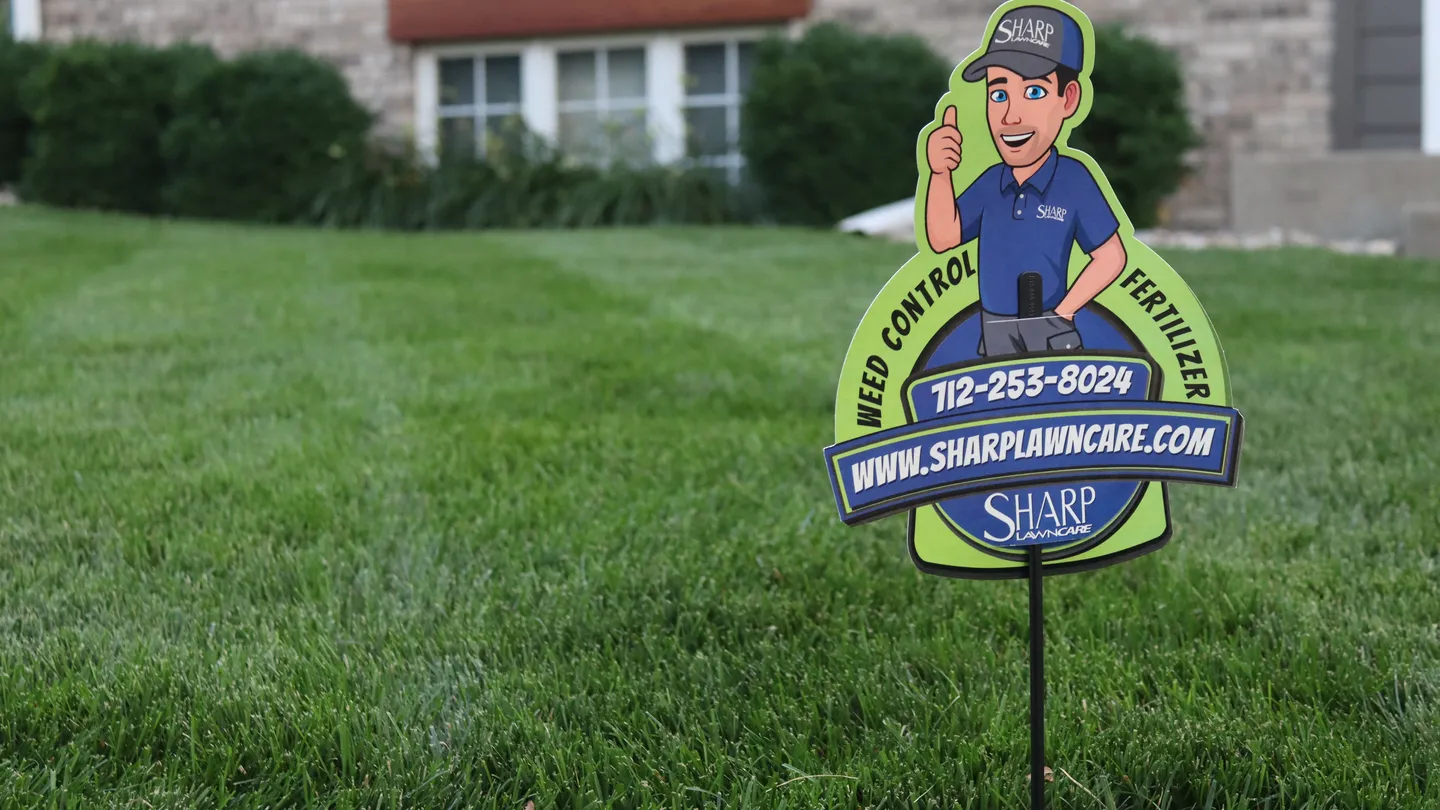
When homeowners in the Siouxland area start thinking about professional lawn care, the first question is almost always the same: how much does it cost? It’s a fair question—and the answer depends on more factors than most people realize. This guide breaks down what professional lawn care actually includes, how it compares to doing it yourself, and what drives the price so you can make an informed decision for your property.
What Does Professional Lawn Care Actually Include in Sioux City, IA?
When most people hear “lawn care,” they think mowing. But professional lawn care programs like the ones Sharp Lawn Care provides have nothing to do with mowing—they’re focused on the health of your turf from the roots up.
A full-season professional program typically includes:
- Multiple fertilizer applications timed to your lawn’s growth cycle
- Pre-emergent herbicide to prevent crabgrass and foxtail before they sprout
- Post-emergent weed control to eliminate broadleaf weeds like dandelions and clover
- Soil health support through proper nutrient balance
- Insect prevention and grub control (depending on your package tier)
The goal isn’t just a green lawn for a week or two—it’s building a thick, healthy turf that crowds out weeds naturally and stands up to the heat, drought, and foot traffic that Siouxland summers throw at it.
DIY vs. Professional: The Real Cost Comparison
On the surface, buying a bag of fertilizer and a bottle of weed killer from the hardware store looks cheaper than hiring a professional. But the real cost of DIY lawn care goes well beyond the price tag on those products.
Consider what DIY actually requires:
- Equipment costs—a quality broadcast spreader, a backpack or tank sprayer, calibration tools, and safety gear
- Product costs—multiple bags of fertilizer, pre-emergent, post-emergent herbicide, and potentially grub control products throughout the season
- Time investment—researching products, calibrating equipment, applying treatments on the right schedule, and cleaning up afterward
- Risk of mistakes—applying too much fertilizer burns your lawn, applying too little wastes your money, and mistiming weed control renders it ineffective
When you add up the equipment, the products, and the hours spent on each application, the real cost of DIY lawn care often comes surprisingly close to what a professional program costs—with far less predictable results. Professionals use commercial-grade products that aren’t available at retail stores, and they know exactly when and how to apply them. As we’ve covered before, there are good reasons why fertilization and weed control are best left to the pros.
Understanding Lawn Care Package Tiers
Not every lawn needs the same level of care, which is why professional lawn care companies offer tiered packages. At Sharp Lawn Care, we offer three tiers designed to match different goals and budgets. Here’s a look at how our lawn care packages are structured:
Essentials — A Good Lawn
This is the foundation. It covers the core treatments every lawn needs to stay green, fed, and weed-free throughout the growing season. It’s the right fit for homeowners who want a solid, healthy lawn without extras.
Plus — A Great Lawn
Everything in Essentials, plus added protection. This tier adds grub control and lawn insect prevention so you’re not just feeding your lawn—you’re defending it against the pests that can destroy it from below the surface.
Premium — A Great Lawn + More Time on Your Lawn
The full package. In addition to everything in Plus, Premium includes services like core aeration, perimeter pest control, and landscape bed weed control—so your entire outdoor space looks sharp and you can actually enjoy spending time in your yard without battling mosquitoes or weeds in your flower beds.
Exact pricing depends on your lawn size in square feet, and the best way to see what your specific property would cost is to get a free customized quote through our online estimator. It takes about two minutes.
What Drives the Cost of Lawn Care?
Several factors influence what you’ll pay for a professional lawn care program:
- Lawn size (square footage)—larger lawns require more product and more time per visit, which directly affects cost
- Current condition—a lawn that’s been neglected may need additional treatments in the first season to get it back on track
- Number of treatments per season—most programs include 5–6 visits per year, but lawns with more issues may benefit from additional applications
- Add-on services—aeration, overseeding, grub control, and pest control services add value but also add to the total investment
The good news is that most homeowners in the Siouxland area find professional lawn care fits comfortably within their budget, especially when they factor in everything they’d spend trying to do it themselves. Check our pricing page for a general overview of how our programs are structured.
The Hidden Costs of Skipping Professional Care
One of the biggest misconceptions about lawn care costs is that skipping professional treatment saves money. In reality, the opposite is often true. Problems that go unaddressed don’t stay small—they compound.
Weed takeover is the most common example. A lawn without pre-emergent and post-emergent weed control can go from “a few dandelions” to “more weeds than grass” in a single season. At that point, you’re not looking at a simple treatment program—you’re looking at a full lawn renovation with aeration, heavy overseeding, and possibly even soil amendment. That costs significantly more than a year of preventive care.
Grub damage is another expensive surprise. Grubs feed on grass roots below the surface, and by the time you notice the damage—brown patches that peel up like carpet—the destruction is already done. Repairing grub damage means killing the grubs, repairing the soil, and reseeding the affected areas. Prevention through a professional program costs a fraction of what repair requires.
Soil compaction slowly strangles your lawn’s root system over time. Without regular aeration, water and nutrients can’t reach the roots, and your lawn gradually thins out no matter how much you water or fertilize. The cost of annual aeration is minimal compared to the cost of restoring a lawn that’s been starved by compacted soil for years.
Is Professional Lawn Care Worth It?
The short answer: yes—if you value your time, want predictable results, and prefer to avoid the costly mistakes that come with guessing at products and timing. We’ve written in depth about whether professional lawn care is worth the investment, and the data consistently supports it.
Sharp Lawn Care’s 100% Satisfaction Guarantee: If you’re not happy with your results, we’ll make it right. If we can’t fix it, we’ll pay a competitor to do it. No loopholes, no fine print.
Beyond the guarantee, here’s what sets a professional program apart:
- Proven Roadmap process—Aerate, Fertilize + Weed Control, Seed in fall, Mow tall, Water deep. This isn’t guesswork; it’s a tested system that delivers the best lawn in the neighborhood in two seasons or less.
- Professional employees—our crews are trained, certified employees, not subcontractors. They know the products, the equipment, and the local conditions.
- Quality control inspections—we don’t just treat and leave. Our team inspects results and adjusts your program as needed throughout the season.
- Commercial-grade products—the professional formulations we use are more effective and longer-lasting than anything available at retail stores.
Get Your Free Customized Quote
Every lawn is different, and the best way to know exactly what professional care would cost for your property is to get a quote tailored to your lawn size and goals. Our online estimator gives you transparent pricing in about two minutes—no sales calls, no pressure. If you're just getting started this season, our spring lawn care checklist walks you through every step in the right order.
Prefer to talk to a real person? Call our Sioux City office at (712) 253-8024. We serve Sioux City, Sergeant Bluff, Le Mars, Dakota Dunes, and surrounding communities throughout the Siouxland tri-state area.

Comments (0)
Thanks for your comment!
Thanks for your feedback! Your comments have been successfully submitted! Please note, all comments require admin approval prior to display.
Error submitting comment!
There is a problem with your comment, please see below and try again.